
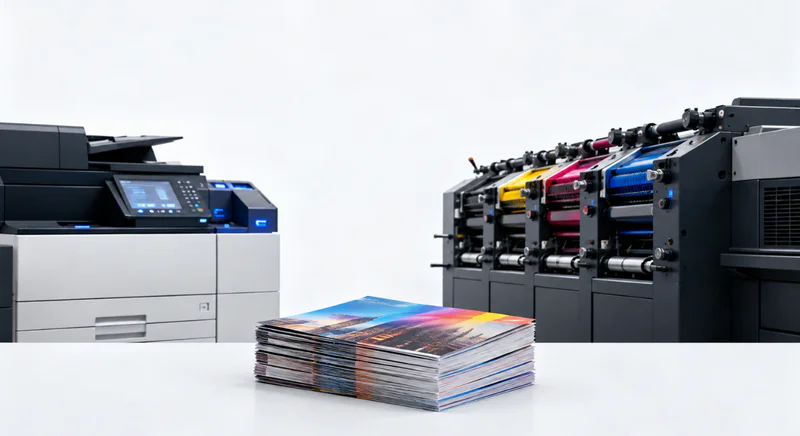
Choosing the right printing method can have a bigger impact on your project than you might expect. The production process you select can influence print quality, turnaround time, customization options, material choices, and your overall budget.
For businesses, those details matter. A marketing team preparing last-minute event flyers has very different priorities from a company ordering thousands of annual catalogues. Similarly, personalized direct-mail campaigns require a different production approach from standardized corporate stationery.
That is why understanding digital printing vs offset printing is useful before placing your next order.
Both methods can produce professional results, but each has different strengths. The right choice depends on your quantity, timeline, artwork, material, finishing requirements, colour expectations, and level of personalization.
Businesses exploring professional online printing services should therefore consider the complete project rather than choosing a production method based on price alone.
In this guide, we break down digital printing vs offset printing, explain where each method works best, and help you make a more informed choice for your next custom printing project.
What Is Digital Printing?
Digital printing is a modern printing process in which artwork from a digital file is transferred directly onto the chosen printing material.
Unlike traditional offset printing, digital printing does not require printing plates. This reduces setup requirements and can make production faster and more practical for smaller quantities.
Digital printing is commonly used when businesses need:
Small or medium print quantities
Faster turnaround
Multiple artwork versions
Personalized information
Frequently changing designs
Short-run promotional materials

It works particularly well for materials such as custom flyers, leaflets and pamphlets, brochures, business cards, invitations, event collateral, posters, and personalized marketing pieces.
For example, imagine your marketing team needs 300 promotional flyers for an upcoming event. You also need slightly different versions for Mumbai, Bengaluru, and Delhi. Because digital printing makes artwork changes easier to accommodate, producing regional variations can be more practical.
Digital printing is also useful for professional networking materials. PrintStop's matte visiting and business cards, for example, are produced using digital printing, illustrating how the process can be applied to relatively small quantities of professional branded collateral.
For businesses exploring different customization techniques, PrintStop's guide to customization options also provides additional information about digital printing and artwork preparation.
What Is Offset Printing?
Offset printing is a commercial printing method that traditionally uses printing plates to transfer an image onto a rubber blanket before transferring it to the final printing surface.
The process requires more preparation because plates must be created and the press needs to be set up before the production run begins.
That extra setup can make offset printing less practical for very small quantities. However, once the press is ready, the method can become highly efficient for larger print runs.
Offset printing is often considered for materials such as:
Catalogues
Magazines
Corporate stationery
Packaging
Annual reports
Large promotional campaigns
High-volume brochures
Recurring printed materials
For example, a company producing thousands of identical product catalogues may find offset printing more suitable than producing the same high-volume job digitally.
Businesses considering catalogue and brochure projects can explore different custom brochure and catalogue printing options to understand how paper, size, folds, lamination, and quantity can influence the final specification.
Digital Printing vs Offset Printing: Key Differences

When comparing digital printing vs offset printing, there is no single factor that determines which process is better.
Quantity, customization, timing, materials, colour requirements, and budget should all be considered.
The important point is that digital and offset printing solve different business requirements.
A project ideally suited to digital printing could become unnecessarily complicated through offset production. Likewise, a very large standardized job might be less economical if it is produced digitally.
Digital and Offset Printing: Which Is More Cost-Effective?
Cost is often one of the first questions businesses ask when comparing digital and offset printing.
The answer usually depends heavily on quantity.
Digital printing generally involves fewer upfront production requirements because printing plates are unnecessary. For smaller runs, this can make the total project more economical.
Offset printing involves more initial setup. However, those setup costs can be spread across a larger quantity, potentially making the per-unit cost more attractive as production volume increases.
Consider two situations.
Your sales team needs 150 high-quality brochures for an upcoming presentation. Setting up an offset press solely for that quantity may not be worthwhile.
Your company then needs 50,000 standardized brochures for nationwide distribution. At that scale, offset production may become considerably more efficient.
Businesses should therefore avoid evaluating custom printing services purely through cost per piece.
The total project may also involve:
Artwork preparation
Proofing
Paper selection
Lamination
Folding
Binding
Specialty finishing
Packaging
Delivery
Multiple versions
For example, a booklet project can involve different page counts, paper stocks, binding, and lamination. Reviewing actual custom booklet printing options can help teams understand why specifications need to be considered alongside quantity.
Which Printing Method Offers Better Print Quality?
Modern digital printing equipment can produce excellent results for many corporate and marketing applications.
For brochures, business cards, flyers, presentation materials, posters, and other everyday branded collateral, digital printing can deliver crisp text, strong images, and professional colour reproduction.
Offset printing continues to offer particular advantages where extremely consistent colour reproduction across large quantities is important.
Imagine a brand producing thousands of premium catalogues in which specific corporate colours need to remain highly consistent throughout the run. Offset production may be an appropriate solution depending on the printer, paper, inks, and project specifications.
The better question is therefore not:
"Is digital or offset printing higher quality?"
Instead, ask:
"Which printing process best meets the quality requirements of this project?"
Print quality depends on more than the technology alone. Important factors can include:
Artwork resolution
Colour profiles
Paper quality
Printing equipment
Press calibration
Ink or toner
Finishing
Proofing
Operator expertise
Paper can be especially important. Different stocks can dramatically change how colours, images, and finishes appear in the completed piece.
Which Option Is Better for Fast Turnaround?
When deadlines are tight, digital printing generally has an advantage because there are no traditional plates to prepare.
This makes it particularly suitable for urgent marketing and workplace requirements.
Imagine your events team discovers that conference attendance is significantly higher than expected. You suddenly need additional flyers, signs, handouts, or supporting marketing materials.
Digital production may help you respond more quickly.
Businesses preparing campaigns can explore PrintStop's broader range of custom marketing and promotional materials, which includes flyers, brochures, booklets, signages, and retail advertising materials.
Digital printing can also be useful for short-run signage requirements. For instance, custom printed posters can support workplace communication, promotions, events, or branded displays.
Offset printing requires additional preparation, so it generally works better when production can be planned in advance.
An annual product catalogue is a good example. If your marketing team knows the artwork deadline, print quantity, distribution schedule, and specifications ahead of time, the additional setup time may not create a problem.
Remember that the printing method is only one element of turnaround. Finishing, material availability, proof approval, order quantity, and delivery requirements can also influence the schedule.
Digital Printing vs Offset Printing for Custom Printing
Customization is one of the areas where the differences between the two processes become especially useful.
Digital printing works particularly well for personalized and variable-data projects because individual information can potentially change between printed pieces without rebuilding the complete production setup.
This may include:
Employee names
Customer names
Addresses
Unique QR codes
Promotional codes
Membership numbers
Regional messages
Location-specific information
Different languages
Personalized images
Imagine an HR team producing employee appreciation cards for hundreds of employees.
The brand design remains the same, but each card contains a different employee name or personalized message. Digital printing can be highly suitable for that kind of custom printing requirement.
The same principle applies when organizations want individually customized corporate communication or marketing collateral.
Offset printing generally makes more sense when large quantities of the exact same artwork are required.
For example, thousands of standardized presentation folders used throughout the company may be better suited to a bulk production workflow. Businesses requiring this type of collateral can review custom folders and dockets to see the types of printing, pouch, card-slot, and lamination options that can form part of a folder project.
The key is to match the production method to the type of customization you actually need.
When Should Your Business Choose Digital Printing?
Digital printing is often a strong option when speed, flexibility, personalization, and smaller quantities are priorities.
You Need a Smaller Print Quantity
If you only need dozens or hundreds of pieces, digital printing can prevent you from paying for unnecessary plate preparation.
Business cards are a good example.
Companies can select from a broad range of custom visiting and business cards depending on their desired paper, format, finish, and branding needs.
Businesses looking for a traditional professional appearance may choose standard visiting cards, while those looking for a more distinctive format can consider square business cards.
You Have a Tight Deadline
Simpler setup can make digital printing more suitable for urgent promotional campaigns, workplace communication, presentations, conferences, or events.
Your Artwork Changes Frequently
Marketing teams regularly update:
Prices
Offers
Product information
Contact details
Event dates
Campaign messaging
Locations
QR codes
Digital printing makes it easier to manage relatively small runs when those details change regularly.
You Need Personalized Materials
Variable-data capabilities are particularly valuable for direct marketing, personalized communication, invitations, customer programs, and internal employee campaigns.
You Want to Test a Design Before Ordering in Bulk
Ordering a smaller quantity can allow your team to evaluate a new design or campaign before committing to a much larger production run.
This approach can be useful for:
New product launches
Rebranding
New sales collateral
Packaging tests
Event campaigns
Market-specific designs
When Should Your Business Choose Offset Printing?
Offset printing becomes particularly attractive when high volume, consistency, and production efficiency matter most.
You Need Thousands of Identical Pieces
Large quantities help distribute offset's initial setup requirements across more printed units.
Catalogues, recurring corporate materials, and large campaigns are common examples.
Colour Consistency Is a Major Priority
Offset printing can provide excellent colour control across large runs, making it useful for organizations with strict branding requirements.
You Produce Recurring Corporate Materials
Organizations regularly producing stationery, catalogues, marketing collateral, or forms may benefit from planning larger standardized runs.
Corporate stationery is one example.
Businesses can explore PrintStop's range of customized office stationery and supplies to understand the different products that may form part of an organization's recurring printing requirements.
For formal communication specifically, custom company letterheads can help maintain consistent branding across official documents and correspondence.
You Require Specialized Production
Offset printing can provide access to additional production possibilities depending on the press and printing provider.
Before deciding, discuss:
Paper stocks
Colours
Coatings
Finishes
Binding
Folding
Cutting
Special inks
Final dimensions
Your Project Allows Sufficient Setup Time
Offset is easier to accommodate when your artwork and specifications can be finalized well ahead of the required delivery date.
Custom Printing for Marketing Materials
Marketing teams rarely print just one type of material.
A single campaign might require brochures, flyers, posters, booklets, folders, packaging inserts, signage, and promotional materials.
This makes production planning especially important.
Rather than automatically choosing digital or offset for the complete campaign, evaluate each item separately.
For example:
Flyers: Short or urgent runs may be well suited to digital printing. Explore personalized brochures and flyers for available formats and customization possibilities.
Brochures and catalogues: Quantity, page count, folds, finishing, and distribution should guide the production decision. PrintStop offers configurable brochure and catalogue printing for different business applications.
Booklets: These may require consideration of page count, binding, paper, and lamination. An A4 portrait booklet, for example, can accommodate a range of page counts for detailed branded communication.
Posters: Short-run promotional or workplace displays can benefit from custom poster printing.
Thinking about each component individually helps businesses create a printing strategy rather than forcing every item into the same production method.
Digital vs Offset Printing for Packaging
Packaging adds another layer to the digital-versus-offset decision.
Your choice may depend on:
Number of units
Packaging material
Box size
Number of artwork versions
Personalization
Product variations
Finishing
Branding requirements
A small business testing new packaging may prioritize flexibility and smaller quantities, while an established company producing large quantities of identical packaging may place greater emphasis on production efficiency.
Businesses exploring branded packaging can review different custom packaging boxes, labels, and stickers to understand the variety of materials and formats that may need to be considered.
The same principle applies here: do not choose the printing technology before defining the packaging requirement.
How to Choose the Right Custom Printing Services for Your Business
Choosing between digital and offset is only part of the process.
The experience, equipment, quality controls, proofing process, and production capabilities of your printing partner can have just as much impact on the finished result.
When evaluating custom printing services, consider the following factors.
Look for Broad Printing Capabilities
A provider with a broad range of capabilities can recommend production based on your actual requirements rather than attempting to fit every job into a single process.
This is especially important for companies managing everything from business cards and corporate stationery to marketing collateral and packaging.
PrintStop's broader customized printing solutions for businesses, for example, span business printing, branded merchandise, marketing materials, workplace essentials, and related requirements.
Ask About Print Quality and Colour Management
Brand colours need to appear as consistently as reasonably possible across customer and employee touchpoints.
Ask your provider how it manages:
Colour
Artwork
Proofs
Print consistency
File preparation
Repeat jobs
Review Material Options
Paper weight, texture, coating, and finish can change both the visual appearance and physical feel of a printed product.
Your printing partner should be able to explain which materials are appropriate for your intended application.
Check Finishing Capabilities
Your project may require more than printing.
Depending on the product, finishing may include:
Matte lamination
Gloss lamination
Folding
Binding
Cutting
Embossing
Foiling
Specialty coatings
Discuss these details before finalizing the production method.
Understand the Proofing Process
Proofing is an important quality-control step.
Before approving your job, confirm:
Final dimensions
Artwork
Text
Contact information
Colours
Quantity
Paper
Finishing
Delivery details
A proof can identify errors before they are reproduced across hundreds or thousands of pieces.
Evaluate Customization Support
If your project contains different names, codes, locations, offers, or artwork variations, discuss how those changes will be managed before placing the order.
Consider Corporate Printing Experience
Business printing can become operationally complicated.
HR, Admin, Marketing, Procurement, and Sales teams may all need printed products with consistent branding but different quantities and deadlines.
An experienced provider should understand those practical requirements and help simplify production rather than simply process individual orders.
Review the Provider's Broader Expertise
Experience can also help businesses assess whether a provider is equipped to support changing requirements over time.
You can learn more about PrintStop and its printing background when evaluating the company for business printing requirements.
Can Businesses Use Both Digital and Offset Printing?
Yes.
Businesses do not need to choose one method permanently.
In many cases, using both digital and offset printing can create a more flexible printing strategy.
You might use digital printing for:
Event flyers
Personalized invitations
Short-run brochures
Business cards
Regional marketing
Prototype materials
Urgent campaigns
Posters
You might use offset printing for:
High-volume catalogues
Recurring corporate stationery
Large standardized campaigns
High-volume packaging
Bulk promotional collateral
Even within one campaign, different production methods may be appropriate.
Suppose your company launches a nationwide campaign.
You could have a large quantity of standardized marketing collateral produced for broad distribution while separately creating short-run regional pieces containing local contact information or offers.
The goal is not to remain loyal to one technology.
The goal is to use the technology that makes the most sense for each requirement.
Digital Printing vs Offset Printing: Quick Decision Guide
Still deciding between digital printing vs offset printing?
Use this simple framework.
Choose digital printing if:
You need a relatively small quantity.
Turnaround speed is important.
Your designs change regularly.
You need multiple versions.
Individual pieces require personalization.
You want to test a campaign before printing at scale.
Choose offset printing if:
You require a large quantity of identical pieces.
Colour consistency across a large run is important.
You need specialized production specifications.
The project can accommodate additional setup time.
Cost efficiency at high volume is a priority.
For complicated projects, discuss your specifications with an experienced custom printing services provider before deciding.
Quantity is important, but it should never be the only factor.
Choose the Printing Method That Fits Your Business Needs
There is no universal winner in the digital printing vs offset printing debate.
Digital printing works particularly well when businesses need flexibility, shorter quantities, fast production, artwork variations, or personalization.
Offset printing is often ideal for larger standardized runs where production efficiency, colour consistency, or specific commercial printing requirements are priorities.
The best decision starts with a clear project brief.
Before requesting a quote, define your:
Quantity
Budget
Deadline
Dimensions
Artwork
Material preferences
Brand requirements
Personalization needs
Finishing options
Delivery expectations
Then discuss those requirements with an experienced custom printing services provider.
Instead of asking which technology is universally "better," ask which method is better for the specific job in front of you.
Not sure whether digital or offset printing is right for your next project? Explore PrintStop's online printing and customization solutions or speak with a printing specialist about your quantity, timeline, artwork, materials, finishing requirements, and budget.