
The word "GSM" covers a huge range. From the sheet in your office printer to the board-like card that makes an impression the moment someone picks it up, there are at least 8 meaningful weight categories in between. Getting this wrong means reprints. Getting it right means a print job that does exactly what it was supposed to do.
Most businesses order the wrong GSM. The print comes back looking cheap, the business cards feel flimsy in a client's hand, or the letterhead jams every laser printer in the office. That is money spent on a reprint that a quick check of the paper thickness chart could have avoided.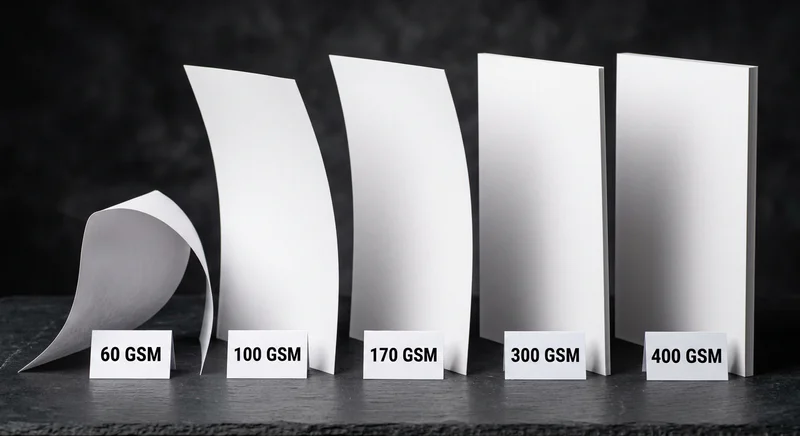
This guide breaks down what GSM means, includes a full GSM paper weight chart from 60 to 450 GSM, covers the right weight for every print product, and gives you a decision framework for ordering from vendors in India.
Key Takeaways
GSM = Grams per Square Metre. Higher GSM means heavier, thicker paper.
80 GSM is standard A4 copy paper. 350 GSM is a professional business card. 450 GSM is a luxury board-like cardstock.
PrintStop stocks a wider standard GSM range than most Indian print vendors, from 80 GSM office stationery through to 400 GSM premium cardstock.
Paper finish (gloss, matte, uncoated) is separate from GSM and changes how the same weight looks and feels.
Letterheads above 120 GSM risk jamming standard office laser printers. Business cards below 300 GSM feel flimsy and can hurt brand perception.
What Is GSM in Paper?
GSM stands for Grams per Square Metre. A one-square-metre sheet of the paper is cut and placed on a precision scale. Whatever it weighs in grams is the GSM. Higher GSM means heavier, thicker paper. Lower GSM means lighter, thinner paper.
Here is the simplest mental model:
80 GSM = the standard A4 copy paper in your office printer right now
350 GSM = the visiting card you hand someone across a table
450 GSM = thick, board-like card that feels almost rigid in the hand

Paper Weight vs Paper Thickness
Paper weight (GSM) and paper thickness are related, but not the same. Weight is measured on a scale. Thickness is measured with a calliper in mm or microns.
A heavier paper is usually thicker, but not always. Cotton-based paper used in premium stationery can be physically thicker than standard coated cardstock of the same GSM, because fibre type and density affect how a sheet feels in hand. When rigidity matters most, such as for a visiting card that needs to feel substantial, ask your vendor for the calliper measurement alongside the GSM.
GSM vs LBS
India uses GSM exclusively. Most local vendors will never quote LBS. The LBS system is used in the US, and if you are ordering from a global vendor or dealing with imported stock, you may encounter it. One rough conversion is sufficient: 80 GSM is approximately 20 lb bond paper. For the Indian market, this is all you need to know.
How Is GSM Actually Measured?
A one-square-metre sheet is cut and placed on a precision scale. Whatever it weighs in grams is the GSM. This is the same regardless of whether the paper is A4, A3, or any other size. The measurement is always standardised to one square metre.
This consistency is why GSM has become the international standard. Unlike the US pound system, where the same number can mean different things for different paper grades, GSM always means the same thing.
GSM Paper Weight Chart - A Quick Reference
Not sure which weight you need? Here is a quick reference of the paper thickness GSM chart. Scroll down for the full product-by-product breakdown.
A note on vendor stock ranges: most Indian print vendors stock 80, 130, 170, 250, 300, and 350 GSM as their standard options. Requesting anything outside this range may attract a surcharge or a longer turnaround.
4 Types of Paper Stock

Before picking a GSM, you need to know which type of paper stock you are dealing with. GSM ranges mean different things depending on the stock. 100 GSM in writing paper is not the same product as 100 GSM in text paper.
The two broad categories are light paper stocks, which can be folded easily by hand, and heavy paper stocks, which require scoring to fold cleanly. This single distinction is the most practical dividing line a print buyer needs.
1. Writing Paper (Light Stock)
Everyday notebook and printer paper used for informal or office purposes. This is the stock most people across India interact with daily: the A4 ream in the office printer.
GSM range: 50-90 GSM.
Best for: internal memos, notepads, basic branded office stationery, rough drafts.
2. Text Paper (Light Stock)
Commercial printing paper used for business materials, book pages, and mass-print collateral. Slightly heavier and crisper than writing paper.
GSM range: 105-150 GSM.
Best for: brochures and flyers, catalogues, book interiors, magazine pages.
3. Cover Stock (Heavy Stock)
Thick, often coated paper used for premium business materials. Requires scoring before folding. Measured in points (pt) for thickness as well as GSM.
GSM range: 170-300 GSM.
Best for: booklet covers, premium flyers, menus, invitation cards, folder covers.
4. Cardstock (Heavy Stock)
The thickest paper category, typically uncoated or with specialist finishes. Built to withstand physical stress: wallets, handling, repeated pickup. This is why visiting cards are always printed on cardstock. They need to survive daily wear without curling, bending, or fraying at the edges.
GSM range: 300-450 GSM.
Best for:custom visiting cards, postcards, retail tags, premium packaging inserts.
Paper Finishes Explained: Coated vs Uncoated, Gloss vs Matte
GSM tells you the weight. Finish determines how the paper looks, feels, and performs under ink. A 170 GSM gloss brochure and a 170 GSM matte brochure are the same weight, but they create completely different impressions.
1. Coated Gloss
Bright, reflective, vivid colour reproduction. The most common commercial printing finish in India. Not suitable for writing on. Best for flyers, retail brochures, product catalogues, and anything where maximum colour impact is the goal.
2. Coated Matte / Silk
Muted, sophisticated, low-glare surface. Better for reading-heavy content. Popular for corporate reports, premium menus, and B2B brochures in India. Perceived as more premium than gloss in professional contexts.
3. Uncoated
Absorbs ink, slightly rougher texture, lower cost. Uncoated paper is the correct choice for anything that needs to be written on: letterheads, notepads, and branded office stationery.
One practical note: uncoated paper absorbs more ink, which can cause colour to appear slightly less vibrant and increase the risk of show-through on lightweight stocks. This is why letterheads are best kept at 90-100 GSM minimum. Thin uncoated paper at 80 GSM with heavy ink coverage will show bleed on the reverse.
4. Specialty Finishes, Velvet Lamination, Soft-Touch, Embossing
These are lamination or post-press finishes applied over the base paper, not the paper stock itself.
Embossing (raised text or graphics pressed into the surface) and debossing (the reverse) require thick paper to work correctly. Paper that is too thin will tear under press pressure. A minimum of 300 GSM is recommended for embossing. This is one of the functional reasons premium visiting cards are printed at 350 GSM or above, not just an aesthetic one.
Velvet lamination on 400 GSM is among the most popular premium visiting card combinations among Indian startups and luxury retail brands. The soft-touch surface paired with board-like rigidity creates an impression that stays with people long after the meeting ends. \
Which GSM for Which Product?
Different print products have different structural and tactile requirements. This is the GSM paper chart guide for what to order in India, GSM range, finish options, and what to watch out for.


How to Choose the Right Paper Thickness
Once you know the product, here is how to land on the right weight within the recommended range. Four factors drive the decision.
1. Budget
Higher GSM means more material cost per sheet, and on some stocks, slower press speeds. Both add to the final price. If the budget is tight, work within the lower end of the recommended range. A 150 GSM brochure prints and folds cleanly. A 130 GSM brochure does too, at a slightly lower cost.
2. Design Requirements
Heavy ink coverage, embossing, various types of printing techniques and specialty finishes all need a higher GSM. If your design has a full-bleed dark background or a foil stamp, go to the upper end of the recommended range. Thin paper under a heavy design warps and shows through on the reverse.
3. Practical Function
How will this piece be used? A menu handed to customers daily needs lamination and 250 GSM at minimum. A one-time event flyer sits comfortably at 130 GSM. A letterhead that runs through office laser printers must stay at or below 120 GSM. Function sets the floor. Everything above that is preference.
4. Industry Standards
In India, there are accepted norms for each product category. Visiting cards at 350 GSM. Letterheads at 90-100 GSM. Trifold brochures at 150-170 GSM. Deviating far below these norms signals cost-cutting to the recipient. Deviating far above them adds cost without a clear benefit. The tables in this guide give you the standard range, use them as your starting point, then adjust for budget and design.
Conclusion

80 GSM belongs to the office printer. 350 GSM belongs to a professional handoff. Everything in between has a specific job.
The 4 paper stock types, the paper weight comparison, and the product guide in this article give you everything needed to brief a vendor accurately or place an order with confidence. Getting this wrong means reprints. Getting it right means a print job that does what it was supposed to do, whether that is a trifold brochure that holds its fold, a visiting card that feels premium in a client's hand, or custom packaging that protects the product and represents the brand.
Whether it is your first print order or your fiftieth, the right GSM is the difference between a print job that looks the part and one that makes people ask who printed it.