
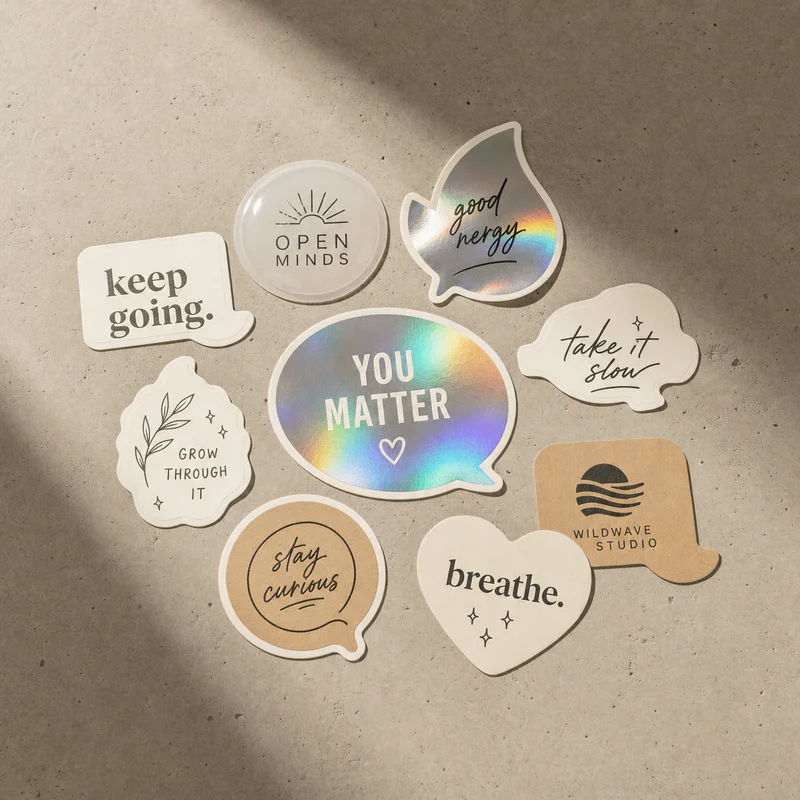
Order the right sticker material and your labels stay put through humidity, handling, and a full monsoon season. Your product stickers look as sharp on week eight as they did on day one. Your vinyl decals complement the kraft box instead of clashing with it. The result is packaging that protects your brand at every touchpoint, as in, no reprints, no delays, no customer who notices something is off.
The material, finish, cut, and format you choose affect how your sticker prints, how long it holds, and what it says about your brand. Get it right once and the decision becomes a reusable brief. This guide covers 8 different types of stickers like paper, vinyl, BOPP, etc., the main finishes, every cut format, and a 4-step decision framework so you leave knowing exactly what to order and why.
Key Takeaways
Paper stickers are the most affordable but not waterproof, use them for dry indoor applications only.
Vinyl is the most versatile material available, covering everything from product labels to outdoor signage with a 3 to 5 year lifespan when laminated.
BOPP is the standard for product labels in food, beauty, and household categories because it resists oils and moisture at volume.
Clear and foil stickers both require high-contrast design, fine detail and thin text get lost on both.
Die-cut and kiss-cut are not interchangeable: die-cut gives a flush edge for individual stickers; kiss-cut keeps the backing intact for easy peel on complex shapes.
Start with surface, environment, and lifespan, the right material follows from those three questions, not from aesthetics.
For enterprise buyers with ESG procurement requirements, eco stickers are not a preference, they are the only range that meets the brief.
Quick Comparison: All Types of Stickers at a Glance
8 Types of Sticker Materials (And When to Use Each)
Choosing a sticker material is a functional decision first. Start by asking: what surface is this going on, and what conditions will it face?
1. Paper Stickers

A thin paper fibre base, the most affordable sticker material available. Available in matte, gloss, and high-gloss finishes. Can be written on with a pen or marker. Not waterproof; moisture damages it quickly and prolonged humidity causes peeling.
Lifespan: Weeks to a few months indoors.
Best for: Packaging inserts, dry food labels, bakery bags, address labels, office labelling, bulk low-cost orders.
When to avoid: Outdoor use, wet surfaces, products exposed to handling or humidity.
Paper stickers earn their place when volume matters more than durability. For a bakery boxing 200 orders daily with kraft bags discarded within hours, paper is exactly right. For a skincare brand whose bottles sit in a bathroom with steam and splashing, it is not.
2. Vinyl Stickers

Plastic-based and the most versatile sticker material available. Two sub-types worth knowing:
White vinyl: Opaque, solid colour coverage, the standard choice for most applications.
Heavy-duty vinyl: Thicker, abrasion-resistant, built for industrial or long-term outdoor use.
Waterproof, scratch-resistant, and weather-resistant as standard.
Lifespan: 3 to 5 years outdoors with lamination.
Best for: Laptop stickers, water bottles, car decals, product labels, brand giveaways, outdoor signage.
When to avoid: Short-term indoor use where paper would be more cost-effective.
3. Clear / Transparent Stickers

Transparent vinyl with a glossy protective laminate, creating the "no-label look." The surface shows through the sticker, so the design feels integrated with the packaging rather than applied on top of it.
Design note: Requires high contrast. Light colours and logos need white ink backing or they disappear entirely against the substrate. Always request a physical proof before approving a run.
Best for: Candles, glass jars, cosmetics, skincare, minimalist packaging, windows.
When to avoid: Heavily detailed designs with thin text or low-contrast elements.
The no-label effect works best when the packaging itself is part of the brand story: a frosted glass jar, an amber apothecary bottle, a clear cosmetics tube. If the design carries a full ingredient list or complex illustration, clear stickers will fight you.
4. BOPP Stickers (Biaxially Oriented Polypropylene)
A plastic-based film that is thinner than vinyl, resistant to oils and chemicals. The standard material for product labels in food, beauty, and household categories. Available in matte BOPP or gloss BOPP. Typically ordered on rolls and cost-effective at higher quantities.
Best for: Shampoo bottles, honey jars, food packaging, kitchen and bathroom products, any label that contacts oils or moisture regularly.
When to avoid: Rough or heavily textured surfaces; prolonged outdoor exposure.
BOPP sits in a useful middle ground: more durable than paper, more economical than vinyl, and genuinely suited to the moisture-heavy environments that food and beauty products live in.
5. Polyester Stickers (PET)
Polyethylene terephthalate, a strong, thin, chemically resistant plastic film. Excellent resistance to heat, chemicals, and tearing. Often used for technical or compliance labelling where durability and precision matter.
Best for: Electronics labelling, beverage packaging, cosmetics, barcode and asset tags, industrial equipment.
When to avoid: When a soft or tactile feel is required; not ideal for highly decorative consumer stickers.
Polyester is the quiet workhorse of industrial and technical labelling. It survives conditions that would destroy paper or standard vinyl: heat near machinery, chemical cleaning agents, extended outdoor exposure. For asset tracking or compliance labels that need to be readable years later, PET is difficult to replace.
6. Holographic Stickers

Vinyl with an iridescent prismatic film that shifts colour with light and viewing angle. Waterproof and suitable for outdoor use.
Design note: Use chunky, high-contrast text. Thin fonts and low-contrast colours get absorbed by the shifting film.
Best for: Merch drops, streetwear-style branding, promo stickers, security seals, limited-edition product releases.
When to avoid: Compliance labels, ingredient lists, or any text-heavy design where legibility comes first.
Holographic works as a brand statement rather than a labelling tool. Using it for a product label with a full ingredient list is where it falls apart.
7. Foil / Metallic Stickers

A metallic foil layer that creates a reflective, premium finish. Available in gold, silver, and mirror variants.
Gold / Silver foil: Catches light, adds contrast, makes logos and text feel elevated.
Mirror vinyl: A highly polished, smooth metallic surface without the texture of foil.
Design note: Simple shapes and bold typography work best. Fine detail gets lost in the reflection.
Best for: Luxury packaging, brand seals, cosmetics, candles, wedding stationery, high-end short-run branding.
When to avoid: Detailed illustrations, small text, or designs requiring multiple colours.
Foil stickers communicate premium before the product is even opened. The discipline required is restraint: the simpler the design, the better the foil reads.
8. Eco / Recycled Stickers

FSC-certified paper, soy-based inks, compostable films, or biodegradable adhesives designed to reduce environmental impact. Available in kraft-style paper or compostable clear film. Typically a matte finish; some variants are writable.
Best for: Artisan brands, kraft packaging, organic food labels, sustainability-focused businesses, and any brand or organisation where eco credentials are part of the procurement brief.
When to avoid: Outdoor use or wet environments unless the specific variant is rated for it. Durability is lower than vinyl alternatives.
Types of Sticker Finishes
The finish sits on top of the material and changes both the look and the durability of your customised stickers. Two stickers with the same vinyl base can read completely differently depending on whether you choose matte or gloss.
Gloss Finish
Vivid colours, light-reflective surface. Shows fingerprints more than matte. Best for product labels and promotions where colour impact and shelf visibility matter.
Matte Finish
Flat, premium, understated. Writable with a pen or marker, useful for handwritten detail labels: dates, flavours, batch numbers. Best for artisan brands, kraft packaging, and labels that need a handcrafted feel.
High-Gloss / UV Coating
An extra protective layer of scratch and moisture resistance applied over standard gloss. The right call for stickers exposed outdoors or handled frequently.
Soft Touch / Velvet Finish
A tactile finish that communicates luxury before the design is even read. Best for high-end cosmetics, lifestyle brands, and premium packaging where the unboxing experience is part of the product.
Sticker Cuts and Formats

Die-Cut Stickers
Both the sticker and the backing are cut precisely to the outline of the design. Clean flush edge. The most premium, professional finish available in custom stickers. Best for brand giveaways, merch drops, and individually sold stickers where presentation matters.
Kiss-Cut Stickers
Only the sticker layer is cut; the backing remains intact as a full sheet or rectangle. Easier to peel for complex or delicate shapes. The backing can carry additional branding, instructions, or a QR code. Best for sticker packs, subscription boxes, and event handouts.
Roll / Label Stickers
High-volume format, labels on a continuous roll with optional perforation for easy tear-off. The most economical per-unit cost at scale. Best for product labelling, fulfilment operations, and retail packaging. This is the format BOPP labels are almost always ordered in.
Standard Shape Stickers
Circles, squares, rectangles, ovals, no custom die required. The most affordable cut. Best for price tags, simple branding, event stickers, and budget-conscious orders.
How to Choose the Right Sticker: A 4-Step Decision Framework
Most sticker ordering mistakes happen because buyers start with aesthetics and work backwards. The right sequence is the opposite: start with the functional requirements and the material choice becomes obvious.
Step 1: Start with the surface
Glass, plastic, metal, cardboard, each surface has different adhesion requirements. Smooth surfaces work with almost any material. Porous, textured, or curved surfaces need permanent adhesive and a flexible material like vinyl. A label that looks correct on flat cardboard will bubble and peel on a curved bottle.
Step 2: Consider the environment
Outdoor, wet, or UV-exposed conditions need laminated vinyl with UV-resistant inks. Indoor dry use can use paper or BOPP. If your product goes into a refrigerator or cold chain, confirm with your vendor before ordering that the adhesive is rated for low-temperature storage. Not all suppliers stock this by default.
Step 3: Set the lifespan
Temporary use, days to weeks, suits removable paper. Short-term use of a few months suits standard vinyl. Long-term use of 3 to 5 years needs heavy-duty or laminated vinyl with UV protection. Match the material lifespan to your actual use case. Paying for durability you do not need adds cost. Ordering a material that will not last adds a reprint.
Step 4: Match finish and cut to your brand goal
Premium brand: foil or soft-touch finish, die-cut singles. Budget bulk run: paper or BOPP on roll. Consumer merch or gifting: holographic or gloss, kiss-cut sheets. Eco-conscious brand or sustainable packaging: FSC paper or compostable film, matte finish.
Conclusion
Choosing the right sticker material comes down to three things: where it lives, what it faces, and how long it needs to last. Get those three right and everything else, finish, cut, adhesive, falls into place naturally.
Paper handles dry indoor labelling at volume. BOPP holds up against moisture, oils, and daily handling. Vinyl is built for outdoor exposure and surfaces that take a beating. Foil and holographic do the heavy lifting for premium brand moments where the material itself makes the impression. Clear steps back and lets the product or packaging speak.
Match the material to the job first. The rest is detail.